Showing posts with label Beshalach. Show all posts

Thursday, January 29, 2026

Singing Of Women

Why does the Torah emphasize that the woman sang as well? Why is it Devorah that sings the song of thanks in the haftorah? The passuk says ותען להם מרים - the mefarshim ask it should have said ותען להן for she was encouraging the women and what is ןתען, who is she answering to? The Riva cites a Midrash that the angles complained they should be able to sing shira after the men and Miraim answered them we (the women) will sing and only after that you can sing. Why is the singing of the women that allows the malachim to sing? 

The Kli Yakar addresses the word להם and he says the woman reached the level of prophesy of the men so it uses the word for men, להם and he concludes his comment וכן לעתיד נאמר (ירמיהו ל״א:כ״ב) נקיבה תסובב גבר. What is the connection between the times of the future and the shira?  

The Meor VaShemesh says the מחולות that the women did is reflective of the מחול שעתיד הקב"ה לעשות לצדיקים (end of Taanis) for it is now that there are different levels but when everyone fixes their portion, is מעלה  the ניצוצות that they need, then everyone is equal. The women are representative of the כלים of acceptance while men are representative of the כלים of giving. In the current construct the givers are above the recipients, in the sefirah order ז"א is higher than מלכות but in the future the recipients will be elevated. He says that is נקיבה תסובב גבר, the giver and recipient, will be equal. Under the great light of the circle there is no male and female, all are equal. This was the light that Miriam was tapping into with the מחול, the circle above division. Moshe said אז ישיר in the future, he wasn't able to bring down that experience at that time but Miriam was so she said שירו לה in the present. (This may answer a question meforshim ask about קול אשה for at this time the boundaries of אשה ואיש were not present.) 

Hashem tells Avraham to listen to Sarah, כל אשר תאמר שרה שמע בקולה. The Bear Mayim Chayim (on the change on name from Sarai to Sarah) says that the letter yud, the first letter of Hashem's name represents the masculine quality of giving forth was changed to a ה which is comprised of a ד and י where the ד comes first, referring to דל, the poor recipient. Sarah was at the level of the future where the feminine force comes first, where the recipient precedes the giver and hence Avraham was told to listen to her.

Any time there is a spark of geulah, a spark of the ultimate geulah present, then the woman's singing carries more weight. Song is an expression of coming full circle. שירה is like the word שיר as in בעלי שיר יוצאין בשיר, it is the recognition of the full circle. When all things are a circle. When what is down becomes equal and elevated to that which is above. That is why it is woman who are more active in the shira.

Thursday, February 6, 2025

Why Did The Sea Split

In davening we say המעביר בניו בין גזרי ים סוף, we refer to Klal Yisrael as banim only when they crossed the yam suf.  Why?  

ויאמנו בה ובמשה עבדו.  The question is what happened now that caused a greater emunah, Klal Yisrael had already seen 10 maakos.  What caused an increase in emunah at this point?  Rav Itzele Blazer (Kocvay Or #3) explains that Klal Yisrael understood that Hashem controls the world and will do miracles to accomplish things for a sensible purpose.  However, at krias yam suf not only where Klal Yisrael saved, but the Egyptians were obliterated.  This was illogical to Klal Yisrael for they were cognizant of the their lowly state as the Midrash says the angels objected, both the Jews and the Egyptians were idol worshippers.  Why do the Jews deserve to be saved and the Egyptians killed?  However, when Klal Yisrael saw that they were saved and the Egyptians drowned they saw that Hashem will even do what seems opposite of logic and their אמונה that Hashem is not limited by the boundaries of human logic increased.  

(As an aside, there seem to be a contradiction in Midrashim both in regard to the makkos and krias yam suf if Klal Yisrael had a zechus or zechusim that validated their redemption or that they weren't really deserving, I'm not sure if they are supposed to be reconciled somehow and what that would be.) 

According to what Rav Itzele is explaining, Klal Yisrael did not have any clear advantage over the Egyptians to warrant the destruction of the Egyptians and yet Hashem deemed them worthy enough to destroy the Egyptians entirely.  Why?  Because they are Klal Yisrael.  They are בניו, the children of Hashem.  One doesn't need a reason to punish an attacker of one's son.  It is the natural desire, irrespective of sechel that motivates one's actions.  כביכול, Hashem stepped in to save his children.  

ויקח משה את עצמות יוסף עמו, why not say Moshe took the aron of Yosef, why the bones?  The Midrash says the yam split due to the aron of Yosef.  Why? The bones of Yosef refers to the עצם, the עצמיות, the essence of Yosef.  In the bones, the very essence of Yosef is the zechus for Klal Yisrael.  Yosef as sent to to Egypt but retained his Jewish identity in Egypt.  The merit of the aron of Yosef is that in the genes of Klal Yisrael is that עצמיות of Yosef, that connection to Hashem remained even as the externality of the Jew was not so apparent.  This is the nature of being בנים, the connection is innate (see Likutay Sichos volume 26.)  

Tuesday, February 4, 2025

Neros Shabbos

The Gemarah Shabbas (23b) says if a person can not afford both wine for kiddush and a candle for Shabbos then buying a candle takes precedence because it is needed for shalom bayis.  Asks the Chayeh Adam, why do we need a new reason of shalom bayis, since the candles are lit erev Shabbos and kiddush is only said on Shabbos, of course the candle take precedence, since it is the mitzvah done first?  

Tosfos in Shabbos (25b) has an opinion that one does not say a beracha on lighting nerot Shabbat.  One of the arguments of Tosfos is that one does not need to actively light a candle for Shabbos, it suffices to have a candle lit for Shabbos.  Rabbenu Tam argues and says one has to actively light a candle for shabbos and his proof is from a Gemarah (23b) here Rav Yosef told his wife not to light the nerot Shabbos to late since it says ״לֹא יָמִישׁ עַמּוּד הֶעָנָן יוֹמָם וְעַמּוּד הָאֵשׁ לָיְלָה״ — מְלַמֵּד שֶׁעַמּוּד עָנָן מַשְׁלִים לְעַמּוּד הָאֵשׁ וְעַמּוּד הָאֵשׁ מַשְׁלִים לְעַמּוּד הֶעָנָן.  Rashi says עמוד הענן - של יום משלים אורו לעמוד האש שהיה עמוד האש בא קודם שישקע עמוד הענן אלמא אורח ארעא בהכי.  The Gemarah then continues that one can't light to early either.  Says Rabbenu Tam, we see there is a proper timeframe for lighting, it doesn't suffice to merely have a candle lit?  Rav Yosef Engel (Beis Haotzer Klal 66) points out according to the first approach in Tosfos, the mitzvah is to have a candle lit on Shabbos . In light of that approach the mitzvah of neros Shabbos is fulfilled on Shabbos when the house is illuminated and the mitzvah starts at the same time as kiddush and we don't have the question of the Chayeh Adam.  But according to Rabbenu Tam that the mitzvah is the act of lighting, the question still stands. 

It is noteworthy that the Magid Mishna (Chanukah 4:5) notes the Rambam understands the Gemarah of not to light too early or too late is referring to the Chanukah candles, not neros Shabbos and this would knock off Rabbenu Tam's proof.  However, this is very difficult since it was the wife of Rav Yosef lit would indicate it is neros Shabbos, see there in Even Haezel that maybe it was erev Shabbos Chanukah, and she was lighting later to light Chanukah candles later, וצ"ע.  

The Mishpitay Uziel (volume 1 #7) uses this debate as a starting point for the discussion if one can fulfill neros Shabbos with electric lights.  According to the approach that one just needs light to exist in the house it should suffice but if one needs an act of kindling a fire, he does not believe merely turning on the light is considered lighting the fire.  

(See also the Griz in the Grach stencil on the opinion of the Rambam and Mishpitay Uziel.)    

Thursday, January 25, 2024

Experiencing Shirah

The Gemarah Sotah (30b-31a) says  דרש רבי יוסי הגלילי בשעה שעלו ישראל מן הים נתנו עיניהם לומר שירה וכיצד אמרו שירה עולל מוטל על ברכי אמו ותינוק יונק משדי אמו כיון שראו את השכינה עולל הגביה צוארו ותינוק שמט דד מפיו ואמרו זה אלי ואנוהו שנאמר (תהלים ח, ג) מפי עוללים ויונקים יסדת עוז היה רבי מאיר אומר מנין שאפי' עוברים שבמעי אמן אמרו שירה שנאמר במקהלות ברכו אלהים ה' ממקור ישראל.  Babies and fetuses do not have the ability to decide to sing shirah.  So why did they say shirah?  Because shirah wasn't a choice as much as it was an outgrowth of the state of existence at the time.  Shirah was not merely sung, it was experienced.    What happened at the yam that caused this outburst of song?  

The Midrash connects the word אז in אז ישיר to the words נָכוֹן כִּסְאֲךָ מֵאָז that the malchut of Hashem was solidified at the time of krias yam suf.  Why was it solidified then more than the makkot?  The maakot were brought for to save Klal Yisrael and punish the Egyptians.  However, the Sifsay Chayim (Sevii shel Pesach) elaborates on the idea that krias yam suf was not a necessary part of the geulah but was just to demonstrate Hashem's dominion over the world.  As he notes, the entire scene of krias yam suf was orchestrated just so that Pharoah would run after Klal Yisrael and there well plenty of miracles that occurred that were not necessary to the salvation of Klal Yisrael such as all the waters of the world splitting.  This is because the yesod of krias yam suf was to bring into the world the manifestation of malchus Hashem.  What does it mean malchus Hashem?  That everything exists only to bring kavod shamayim.  The Egyptians and their deities did not have any independent power that was fighting against Hashem but they too only existed to serve a purpose and were destroyed when they ran their course.  That is why the שירה contains many allusions to the ultimate geulah for then then the message of the malchut of Hashem will permanently take root in the world.  It was this revelation of the malchus of Hashem that took root in the world that left a shirah impression that was felt even by children still in the womb. 

The Shem MeShmuel (5678) cites the Midrash that no one, not Adam, Noach, the Avos etc. said shirah until Klal Yisrael said it at the yam suf.  Why were they the first?  He explains that just as a person can only speak after a person becomes complete as in their body and mind have already taken form, so too for shirah to be experienced as a שכינה מדברת תוך גרונם (his lashon) there needs to be an a combining of many peoples into an entity of one nation.  It is only at this time, אז ישיר , in the singular, that many peoples combine into one nation.  Shirah comes bursting forth when there is unity, a unity experienced on a personal, national and global level.     

Thursday, February 2, 2023

Coming Full Circle

Why do Klal YIsrael mention in the shira the Beit Hamikdash, מקדש ה' כוננו ידך, why was that apropos at that time?  The Gemarah Sanhedrin (94a) says that חזקיהו was not made Mashiach because he did not say shira.  Why is shira a prerequisite to becoming Mashiach?

The Maharal Gevurot Hashem (Ch. 47) says the word אז indicates joining that which is separated to its single source.   He says this is alluded to in the makeup of the word itself.  The word אז is made up of the letters א and ז.  The letter ז stands for all of the possible divisions, the multiple paths that there are and they are joined to a א, to Hashem that controls them.  He says that is the intent of the Zohar that says מהו "אז", אחד רוכב על שבעה. 

The Maharal also says that the word אז means the exact present time, not past or future, it is above the boundaries of time.  In other words, there is division only along the length of a timeline but if one is not bound by the timeline but can see the whole process it one shot, then one can see how all the pieces fit together.  That is why אז is אחד רוכב על שבעה, the unity that is obvious when one looks at the entire picture (see Sifsay Chayim on Shevii Shel Pesach.)  

What does this have to do with shira? The word shira besides meaning song means a circle as in the Mishna Shabbat (5:1) כל בעלי שיר יוצאין בשיר.  In order to sing shira one has to come full circle, one has to see the unity, see the full picture. That is what the Midrash means that the אז of אז ישיר fixed the אז that Moshe said מאז באתי אל פרעה הֵרַע לָעָם הַזֶּה.  Now that Moshe has experienced the full circle, he is able to sing shira.  It is only one who is able to see sing shira, to achieve the shelemut that occurs from finishing the circle that can unite the world in the service of Hashem as is the job of Mashiach.  That is why shira is necessary for Mashiach. 

In the Beis Hamikdash on Yom Kippur the blood was sprinkled אחת למעלה ושבע למטה.  It was אחד רוכב על שבעה.  When one entered the Mikdash one achieved a clarity of the unity of everything.  That is why Mikdash has everything to do with shira.  It is all the same yesod of the recognition of אחד רוכב על שבעה.

Sunday, January 16, 2022

Where Is It

The Daas Zekanim (14:2) asks how can Hashem tell Moshe לפני בעל צפון נכחו תחנו על הים if the Gemorah Sanhedrin (63b) says one can't give the place of somethnig by using an avodah zarah?  נכחו תחנו. תמה להרב רבי יהודה היאך אמר לו שיחנו על הים לפני בעל צפון והא אמרינן אסור לאדם לומר לחבירו המתן לי בצד ע"ז פלונית צ"ע. ולי נראה דדוקא לאדם אבל להקב"ה לא שהרי מצינו שהקב"ה יושב ודן את כל העולם אפילו בשבת ואפילו בר"ה ויום הכפורים אע"פ שלישראל אסור (וכה"ג כתב רש"י ז"ל בר"ה (דף ל' ע"א) ד"ה א"נ דאבני בליליא וכו' ה"מ בנין בני אדם וכו' יע"ש). ועוד נ"ל דעדיין לא נתנה התורה אין לחוש אע"פ שכבר הוא כתובה ומונחת לפני הקב"ה:  

The question is difficult as the Or Sameach Laws of Avodah Zarah points out the Gemorah itself says that an avodah zarah mentioned in the Torah one can mention the name of the avodah zarah?  If one looks carefully at the Gemorah the Gemorah says that heter is for mentioning the name of an avodah zarah but not regarding using an avodah zarah to indicate a place which the Daas Zekanim may have held is still forbidden.  

The first answr that hashem doesn't have to keep the laws is also difficult as the Midrash Shemos (30:9) says Hashem only commands what He keeps?  See discussion about that in the torah forum. 

Thursday, January 13, 2022

Sally Forth

דבר אל בני ישראל ויסעו.  Why did Klal Yisroel have to take a step of their own if the entire process of geulah was a sit back and watch process?  What is the message of the debate between the 4 groups in Klal Yisroel if to return to Egypt, to drown, to daven or to fight?  And what is the answer, a fifth option, to go forth?  The Yam Suf represents the G-dliness that is covered over in the world.  The water covering the path to freedom is concealed and hidden.  This represents the G-dliness that is covered over by the external experience of the world.  The debate that existed between the various sections in Klal Yisroel was how to deal with the battle that exists between the world and the Power behind it.  Some said one must drown themselves in the sea, in the sea of Torah and purity to stay above the world.  Others said that is not possible, lets admit defeat and go back to Egypt.  Some said its in the hands of G-d and lets daven and yet others said we must fight against the great cover up of the world.  Hashem said that when one is on a journey to Mattan Torah, nothing else must stand in the way, go forward.  With all the problems that exist externally and internally of a person, you must still sally forth on your own.  In order to get out of the quagmire of Egypt, it was necessary to be pulled out miraculously.  However, for the end of the geulah to happen, to finally be free of Egypt, it was necessary to take all of one's problems, failures and quandaries and just move forward.  This allows for one to see that all of the makeup of the eprosn is not a defect but can become part of illuminating the world (based upon Torat Menachem 5722.)   

Thursday, January 28, 2021

Cultivating Faith

It is no coincidence that the word אמונה appears only twice in Chumah and once is in this weeks parsha, וַיְהִי יָדָיו אֱמוּנָה עַד בֹּא הַשָּׁמֶשׁ.  For H.W. you can recall where the other time it appears.  On the aforementioned possuk the Likutay Moharan #91 says: וַיְהִי יָדָיו אֱמוּנָה עַד בֹּא הַשָּׁמֶשׁ (שמות י״ז:י״ב):כִּי יֵשׁ כַּמָּה מִינֵי אֱמוּנָה. יֵשׁ אֱמוּנָה, שֶׁהוּא רַק בַּלֵּב. וְהָעִקָּר שֶׁצָּרִיךְ לִהְיוֹת לָאָדָם אֱמוּנָה כָּל־כָּךְ, עַד שֶׁיִּתְפַּשֵּׁט בְּכָל הָאֵיבָרִים.כְּמוֹ שֶׁמּוּבָא בְּכִתְבֵי הָאֲרִ"י, שֶׁצָּרִיךְ לְהַגְבִּיהַּ יָדָיו בִּשְׁעַת נְטִילָה נֶגֶד הָרֹאשׁ, כְּדֵי לְקַבֵּל הַקְּדֻשָּׁה. נִמְצָא שֶׁצָּרִיךְ לָזֶה אֱמוּנָה בְּהַיָּדַיִם, לְהַאֲמִין שֶׁמֵּחֲמַת שֶׁמַּגְבִּיהַּ יָדָיו כְּנֶגֶד הָרֹאשׁ מְקַבֵּל הַקְּדֻשָּׁה,כִּי בְּלֹא אֱמוּנָה אֵינוֹ כְּלוּם, כְּמוֹ שֶׁכָּתוּב (תהילים קי״ט:פ״ו): כָּל מִצְו‍ֹתֶיךָ אֱמוּנָה. וּכְשֶׁיֵּשׁ לוֹ אֱמוּנָה כָּזוֹ, בָּא מִן הָאֱמוּנָה אֶל הַשֵּׂכֶל, וְכָל מַה שֶּׁמַּחֲזִיק אֶת עַצְמוֹ בֶּאֱמוּנָה, בָּא אֶל שֵׂכֶל יוֹתֵר. כִּי הַדָּבָר שֶׁהָיָה צָרִיךְ מִתְּחִלָּה לְהַאֲמִין, עַכְשָׁו כְּשֶׁבָּא אֶל אֱמוּנָה יוֹתֵר גְּדוֹלָה, מֵבִין הַדָּבָר הָרִאשׁוֹן בַּשֵּׂכֶל.

וְזֶה שֶׁכָּתוּב בְּמשֶׁה: וַיְהִי יָדָיו אֱמוּנָה – שֶׁהָיָה לוֹ אֱמוּנָה כָּל כָּךְ גְּדוֹלָה, עַד שֶׁנִּתְפַּשֵּׁט בְּכָל הָאֵיבָרִים, שֶׁאֲפִלּוּ בְּיָדָיו הָיָה הָאֱמוּנָה כָּל כָּךְ גְּדוֹלָה,עַד בֹּא הַשָּׁמֶשׁ – הַיְנוּ לְהַשֵּׂכֶל שֶׁל הַדָּבָר, וְשֶׁמֶשׁ הוּא בְּחִינַת חָכְמָה, כַּמּוּבָא אֶצְלֵנוּ

Generally people think of אמונה either as an emotion or maybe an understanding but what does that have to do with a person's hands?  How can you believe with your hands?!  This week we celebrated טו בשבט, Rosh Hashana of the trees.  What is the celebration, there is no fruit to pluck, you are just eating the bokser from last year?  

The Gemorah in Shabbos (31a) says אָמַר רֵישׁ לָקִישׁ: מַאי דִכְתִיב ״וְהָיָה אֱמוּנַת עִתֶּיךָ חוֹסֶן יְשׁוּעוֹת חׇכְמַת וָדָעַת וְגוֹ׳״. ״אֱמוּנַת״ — זֶה סֵדֶר זְרָעִים.  Rav Kook comments: היסוד הטבעי הוא הדבר שראוי לבקשו בכל ענין, בין בעניני החומר בין בעניני הרוח, וכאשר האלקים עשה את האדם ישר הנה כל התכונות הטובות הנן מוטבעות בו במקור יצירתו, וההפסד המוסרי הבא בעטיין של הנטיות הרעות הנם הדברים המשביתים את טבע הנפש מטהרה, ע"כ היסוד לכל טובה ולכל מוסר עליון, שהוא האמונה, הוא נעוץ בעומק הטבע הישר האנושי, ומשחיתי האמונה הם עוקרים בחזקת היד המלאה זימה ושוחד את האדם ממקור חייו הטבעיים הרוחניים, הנותנים לו שלות לב ושמחת נפש בעוה"ז ואחרית ותקוה לעוה"ב.  Emunah is about bringing out the natural goodness within a person.  Emunah shares the same word as אומן, a craftsman.  Just as the artisan needs to carefully make the vessel or art they are fashioning, so too a person has to cultivate their emunah.  You have to water and give sunlight to the emunah found within you.  When a person lives there life according to the יסוד הטבעי within themselves, that is living with emunah.  That is the emunah of the hands.  The person's hands act according to the way the branches of emunah from within his/her self lean.  When a person has trust in Hashem, it is not just to a mental or emotional reaction, it is a person surrendering to their inner connection to Hashem.  

The Sifsay Tzaddik is bothered by the language of the possuk, וַיִּקְחוּ־אֶ֛בֶן וַיָּשִׂ֥ימוּ תַחְתָּ֖יו וַיֵּ֣שֶׁב עָלֶ֑יהָ, just say וישימו אבן תחתיו?  He suggests it hints to the inner spark inside a person that is the even sheysia of a person that is inherited from the Avos.  They took the light from that even and put it in the stone that Moshe sat upon in order to arouse the souls of the fighters.  It is by awaking the emunah of a person that one can vanquish Amalek.

We are celebrating on טו בשבט not the fruit but the emunah of the tree.  We are celebrating the fact that despite the bitter autumn and winter, the tree will stirs again.  It is able to find its strength and once again burst forth with fruit. 

Wednesday, January 27, 2021

Claim Your Freedom

 As the Torah describes in Parshat Shemos it was the prayers and cries of Klal Yisroel that awakened heavenly mercy to redeem Klal Yisroel.  Yet, when stuck between the Egyptians and the sea G-d says forget the prayers, sally forth, why?  The Bechai in Shemos explains how the 4 terminologies of geulah correspond to different stages in the redemption.  He says the word גאלתי refers to krias yam suf for it is only after the slave sees his master is dead that he can be sure of his freedom.  He says וזהו שלא תמצא לשון גאולה ביציאת מצרים רק אחר אבדן המצריים שנאמר (שמות י״ד:כ״ז) וינער ה' את מצרים בתוך הים וסמיך ליה ויושע ה' ביום ההוא את ישראל כי אז נחשבו גאולים ונושעים ואז היתה התשועה שלמה.  It is only considered גאולה after krias yam suf.  The even of krias yam suf is when the people went from "escaped" slaves to free people.  It is this stage of גאולה that demands more than prayer.  When stuck in the dark depths of Egypt, without any hope of the condition improving, what one must do is pray.  However, when one had already been pulled out of the quicksand, when one is able to stand on their own two feet, they must grab the opportunity to move forward.  G-d may bring you to the water, pull you out of the depths of misery, but you have to drink the waters of freedom.  It is up to man to walk forward and claim his freedom.  It is only when a person is able to claim his freedom that s/he is truly free.

Wednesday, June 3, 2020

Pain To Pray

Why are there צרות, why is a person in pain?  To pray!
דעת חכמה ומוסר סי' ד.


He builds this from the Midrash Beshalach (21:5) אָמַר רַבִּי בֶּרֶכְיָה, יָפָה הָיְתָה הַקְרָבַת פַּרְעֹה לְיִשְׂרָאֵל מִמֵּאָה צוֹמוֹת וּתְפִלּוֹת, לָמָּה, שֶׁכֵּיוָן שֶׁרָדְפוּ אַחֲרֵיהֶם וְרָאוּ אוֹתָן, נִתְיָרְאוּ מְאֹד וְתָלוּ עֵינֵיהֶם לַמָּרוֹם וְעָשׂוּ תְּשׁוּבָה וְהִתְפַּלְּלוּ, שֶׁנֶּאֱמַר (שמות יד, י): וַיִּצְעֲקוּ בְּנֵי יִשְׂרָאֵל אֶל ה', אָמְרוּ יִשְׂרָאֵל לְמשֶׁה, מֶה עָשִׂיתָ לָנוּ, עַכְשָׁו הֵם בָּאִים וְעוֹשִׂים לָנוּ כָּל מַה שֶּׁעָשִׂינוּ עִמָּהֶם, שֶׁהָרַגְנוּ בְּכוֹרֵיהֶם וְנָטַלְנוּ מָמוֹנָם וּבָרַחְנוּ, לֹא אַתָּה אָמַרְתָּ לָנוּ (שמות ה ג, כב): וְשָׁאֲלָה אִשָּׁה מִשְּׁכֶנְתָּהּ, בְּאוֹתָהּ שָׁעָה הָיוּ עוֹמְדִים וְלֹא הָיוּ יוֹדְעִים מַה לַּעֲשׂוֹת, וְהָיָה הַיָּם סוֹגֵר, וְהַשֹּׂוֹנֵא רוֹדֵף, וְהַחַיּוֹת מִן הַמִּדְבָּר, שֶׁנֶּאֱמַר (שמות ה יד, ג): סָגַר עֲלֵיהֶם הַמִּדְבָּר, אָמַר רַבִּי יִרְמְיָה בֶּן אֶלְעָזָר אֵין סָגַר אֶלָּא חַיּוֹת, שֶׁנֶּאֱמַר (דניאל ו, כג): אֱלָהִי שְׁלַח מַלְאֲכֵהּ וּסֲגַר פֻם אַרְיָוָתָא. כֵּיוָן שֶׁרָאוּ יִשְׂרָאֵל שֶׁהָיוּ מֻקָּפִין מִשָּׁלשׁ רוּחוֹת, הַיָּם סוֹגֵר, וְהַשֹּׂוֹנֵא רוֹדֵף וְהַחַיּוֹת מִן הַמִּדְבָּר, תָּלוּ עֵינֵיהֶם לַאֲבִיהֶם שֶׁבַּשָּׁמַיִם וְצָעֲקוּ לְהַקָּדוֹשׁ בָּרוּךְ הוּא, שֶׁנֶּאֱמַר: וַיִּצְעֲקוּ בְנֵי יִשְׂרָאֵל אֶל ה', וְלָמָּה עָשָׂה הַקָּדוֹשׁ בָּרוּךְ הוּא לָהֶם כָּךְ, אֶלָּא שֶׁהָיָה הַקָּדוֹשׁ בָּרוּךְ הוּא מִתְאַוֶּה לִתְפִלָּתָן.

Sunday, March 8, 2020

What To Want

From the Shearis Yisroel Shaar Hiskashrus Likutimm (pg. עו in the new editions.)

Sunday, February 23, 2020

Women And Amalek

An individual in the beis midrah shared with me a text he received which was a picture of the following idea in the sefer דרושי וחידושי הרמבא"ד on Yisro.  It would seem the author was starting early on Adar jokes or got in a big fight with his wife that week or possibly both.

Monday, February 10, 2020

Can't Teach A Drunkard

The possuk (14:21) says  וַיִּֽירְא֥וּ הָעָ֖ם אֶת־י״י֑ וַיַּֽאֲמִ֙ינוּ֙ בַּֽי״י֔ וּבְמֹשֶׁ֖ה עַבְדּֽוֹ.  The order seems backward, first you beleive and then you fear?  How can you fear something before you believe in it?  The Aley Shor brings from Rav Yeruchem that you can't teach אמונה to a שיכור.  Someone who doesn't fear Hashem, one has no concept at all of what it means that there is a G-d, has no capability to have אמונה.  Obviously, then אמונה isn't merely the belief in a supreme being, but is something more.

Thursday, February 6, 2020

We Are Close To God

The simple interpetation of the posuuk at the beginning of the parsha ולא נחם אלקים דֶּ֚רֶךְ אֶ֣רֶץ פְּלִשְׁתִּ֔ים כִּ֥י קָר֖וֹב ה֑וּא כִּ֣י | אָמַ֣ר אלקים פֶּן־יִנָּחֵ֥ם הָעָ֛ם בִּרְאֹתָ֥ם מִלְחָמָ֖ה וְשָׁ֥בוּ מִצְרָֽיְמָה: at face value seems to be a negative view of Klal Yisroel.  At that stage they had just gotten out of Egypt and any thing could easily scare the back.   The Daas Zekanim however, takes the opposite approach.  He says כי קרוב – כלומר העם קרוב של הקב״ה שנאמר לבני ישראל עם קרובו. ולכך לא הנהיגם כמנהגו של עולם.  In place of highlighting our faults, the possuk singles out that even in our lowly state, Hashem was still close to us and hence he led us in our own route.

Sing Again

On the words אז ישיר משה, Rashi in his second interpretation says the reason why ישיר is in future tense is אבל מדרשו: אמרו רבותינו: מכאן רמז לתחיית המתים מן התורה.  According to this derash it means that when the dead will be revived, then אז ישיר will be sung again.  Why, it is long gone and done?
Dovid Hamelech in Tehillim (30) says ה' אלקי שִׁוַּ֥עְתִּי אֵ֝לֶ֗יךָ וַתִּרְפָּאֵֽנִי.  What does Dovid Hamelech being healed from his sickness have to do with building the Beis Hamikdash?  The Even Haezel in his intro. to Kodshim 2 explains that the nature of a person is that if s/he gets sick then all they are thinking about is getting better.  If they are cured, then they give thanks for that.  In they are successful later in life and gain wealth and fame, they have a separate gratitude to Hashem but the thoughts of their days in their sickness are long gone and they no longer are feeling appreciation for surviving.  However, Dovid Hamelech wasn't that way.  He didn't merely sing the praises of Hashem for bringing him from the previous stage to his current stage, but he saw the entire picture.  He gained a deeper appreciation for Hashem helping him out in his times of great need when he can now, later on see a fuller picture and how this led to preparing the Beis Hamikdash.  At this point Dovid Hamelech thanks Hashem again; not a repetition of the old thanks, but as a new message for now he has a deeper appreciation of where being saved when he was sick led too.
This is why אז ישיר will be repeated in the future.  Of course, משה and Klal Yisroel were very happy to survive the Yam Suf.  However, the full effect of this momentous event can only be appreciated in תחיית המתים when the full subsequent string of events and how it was necessary for the final tikkun of the world will be realized.  At that point a new אז ישיר is necessary for they will have a deeper appreciation of the miracle of Krias Yam Suf (based upon וענפיה ענפי ארז.)

Wednesday, February 5, 2020

The Water Reflects Your Face

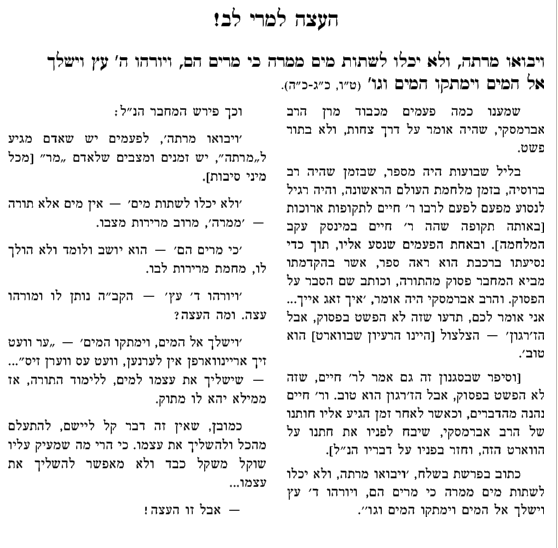
After surviving the Yam Suf, the people complain because all the water in front of them is bitter.  The simple interpretation of the story is that the water was undrinkable   However, the Shemos Rabbah (50:3)  says "כי מרים הם". אמר רבי לוי: הדור היה מר במעשיו.  The bitterness wan't the water, but the people themselves.  The midrash seems to be bothered by the extra word הם and understands that it is a description of the people themselves.  The idea the midrash is conveying is that sometimes all you can see is a reflection of yourself.  The problem wasn't with the water in front of their eyes, the problem was with the people themselves and the water merely mirrored what was in front of it. Some times all people can see in front of them is bitterness, however, its not what lays in front of them, its what lays inside of them that is the problem.  It is by rolling with the punches instead of complaining that leads to success.  This seems to be the lesson the Maggid in מגיד דבריו ליעקב wishes to teach us: וזהו ויבואו מרתה שנפלו לדבר רע ולא יוכלו לשתות כי מרים הם. פירוש העם לא היו טובים דאם היו כדאי אדרבה היה באה להם משם טובה יתירה. דכל דין יש בתוכו חסד ואם היו שוברין את הדין היה בא להם טוב. וזהו ויסעו ממרה ויבואו אלימה דאותיות אלימה הוא אותיות אלהים רק הצירוף הוא הוא כך אלימה נקרא דבר שהחסד שבו אינו מושג וזהו אלי הוא החסד שאינו מושג ואלי לשון אל י' החסד הנמשך מהחכמה היה וזהו פירש הבה לנו עזרת מצר שתהא העזרה באה מכח הצרה.

Tuesday, February 4, 2020

The Purifying Waters Of Torah

The Gemorah in Babba Kammah (82a) says: דתניא (שמות טו, כב) וילכו שלשת ימים במדבר ולא מצאו מים דורשי רשומות אמרו אין מים אלא תורה שנאמר (ישעיהו נה, א) הוי כל צמא לכו למים כיון שהלכו שלשת ימים בלא תורה נלאו עמדו נביאים שביניהם ותיקנו להם שיהו קורין בשבת ומפסיקין באחד בשבת וקורין בשני ומפסיקין שלישי ורביעי וקורין בחמישי ומפסיקין ערב שבת כדי שלא ילינו ג' ימים בלא תורה.  The Maharsha explains where the Gemorah sees in the possuk this derash: דרשינן ליה משום דמה ענין שם שם לו חק וגו' ויאמר אם שמוע וגו' לענין שהלכו ג' ימים ולא מצאו מים וע"כ דרשו שהלכו ג' ימים בלא תורה ונתחזק להם ביטול התורה והיו נלאין לשתות מי התורה כי היו מרים להם כנאמר אם תעזבני יום וכו' עד שהורה להם ה' עץ וגו' שהתורה היא עץ חיים למחזיקים בה והחזקה הוא בכל דבר בג' פעמים וע"כ בהפך זה קאמר שלא יתחזק להן חזקת לינה ג' ימים בלא תורה ובזה ימתקו להן מי התורה.  This is codified by the Rambam in Ch. 12 of the Laws of Prayer: מֹשֶׁה רַבֵּנוּ תִּקֵּן לָהֶם לִישְׂרָאֵל שֶׁיְּהוּ קוֹרִין בַּתּוֹרָה בָּרַבִּים בְּשַׁבָּת וּבְשֵׁנִי וּבַחֲמִישִׁי בְּשַׁחֲרִית כְּדֵי שֶׁלֹּא יִשְׁהוּ שְׁלֹשָׁה יָמִים בְּלֹא שְׁמִיעַת תּוֹרָה.  The Rambam adds one word to the Gemorah, שְׁמִיעַת.  What does this additional word tell us?  Rav Solevetchik explains the Rambam means to highlight that its not the understanding of Torah that Moshe initiated; it is merely just to hear words of Torah itself.  What is the point of merely hearing words of Torah without understanding?

The possuk at the end of Bo says וְהָיָה֩ לְךָ֨ לְא֜וֹת עַל־יָדְךָ֗ וּלְזִכָּרוֹן֙ בֵּ֣ין עֵינֶ֔יךָ לְמַ֗עַן תִּהְיֶ֛ה תּוֹרַ֥ת י״י֖ בְּפִ֑יךָ.  There is a היקש between Torah and tefillin.  In the last post, we saw from Rav Solevetchik that besides the mitzvah of wearing tefillin, it is also a קיום in the person.  The tefillin have an affect on the person as well.  He extends the same thing to the words of Torah as well.  There is the mitzvah of understanding Torah but then there is another aspect to Torah.  That is the spiritual purification that washes over a person when in contact with Torah.  That was the point of the תקנה of Moshe.  The nation had gone through the makkos, krias Yam Suf etc. but all of that was an external experience.  It comes and goes.  That's why a minute later Klal Yisroel were complaining about the state of affairs.  In order to have a lasting affect on the person himself, to quench the spiritual thirst, there must be words of Torah.  The point of the תקנה isn't to learn Torah, but the effect the words of Torah will have on the individual and that is highlighted by it merely being a תקנה to hear words of Torah.

To take this a step further, we can add that not only does Torah purify the person, but it purifies the world as well.  The Gemorah in Shabbos (119b) says אמר ריש לקיש משום רבי יהודה נשיאה אין העולם מתקיים אלא בשביל הבל תינוקות של בית רבן.  The children don't understand what they are learning, there isn't even a fulfillment of Talmud Torah, they are merely memorizing texts, so how does their learning keep the world running?  We see that is the power of the words of Torah that keeps the world running.  Irrespective of the mitzvah, the words of Torah itself have a affect on the world.  We see the same idea from this Gemorah as well.  There was no mitzvah of Talmud Torah yet; it was pre-mattan Torah.  Yet, the words of Torah are what satiated Klal Yisroel.  That is the idea of the midrash that the Maharsha cites that its the עץ החיים, the Torah that sweetened the water.  The מתיקות התורה transformed the water from מר to מתוק.  This may be the understanding of Rav Chayim that the חפצא of the words  of Torah require a beracha,  In order to merely read the words of Torah, to tap into such a spiritual energy source, requires a beracha.

Rav Solevetchik goes on to contrast this תקנה with the later details of עזרה added to the krias hatorah.  He explains that the two תקנות are fundamentally different.  Moshe's תקנה is to hear words of Torah.  Ezra's תקנה is to learn, understand Torah.  (As they say in Jewish, עיי"ש.)  He connects this with their time frames in history as well.  The times of Moshe is the generation of ביאה ראשונה, this כיבוש  was done with the ארון going in front of them.  It is the חפצא of the Torah, the Sefer Torah in the ארון that brings kedusha to the land.  Rav Solevetchik views the kedusha of the land as an extension of the kedusha of the mikdash and therefore it must be done with Torah.  That is the generation of the תקנת משה, to tap into the power of the words of Torah.  In the times of עזרה there was no ארון so how did they extend the kedusha of the מקדש?  He explains that its the תורה שבעל פה as represented by the body of Klal Yisroel that brings the kedusha to the land.   That is the time of תקנת עזרה, to learn and understand Torah.  (Again for more details, עיי"ש.) 

I would like to add that these two types of learning Torah are connected to the two types of relationship one has with God.  The possuk says זה קלי ואנוהו אלקי אָבִ֖י וַאֲרֹמְמֶֽנְהוּ.  The Shla (beginning of י' מאמרות,) explains that these are two types of relationships we have with Hashem.  There is the קלי, how one understands God and His service based upon one's understanding.  Then the relationship is ואנוהו, אני והוא, one has a strong connection to Hashem.  However, if that leads to doubts or is unsuccessful, the fallback is אלקי אָבִ֖י, the emunah that we have built into us from the Avos.  With that approach וַאֲרֹמְמֶֽנְהוּ, Hashem is above me, the connection isn't established well in my heart.
 
The Tanya delineates two basic approaches to understand the possuk כי קרוב אליך הדבר מאד.  The first approach is by learning and contemplating about Hashem.  The second approach, as this blog mentioned last week is that we merely have to awaken within ourselves the natural connection to Hashem that we have from our forefathers.  These are the two relationships described in קלי ואלקי אבי.  The connection to Hashem sown into our DNA is akin to the kedusha of the words of Torah itself.  This connection is beyond human logic, it is the כיבוש of our נפש הבהמית through the Aron.  The second approach is to do a כיבוש on our נפש הבהמית through our understand and learning about Hashem and His Torah.  That is akin to the כיבוש of יהושע through the תורה שבעל פה.  As with the כיבוש of the ארץ, it is only the כיבוש of תורה שבעל פה that exists forever, it can't be removed.  So too, as the Shla says, this is the connection with Hashem that resinates deeper in the heart of a person.   

Thursday, October 10, 2019

Shiras Ha'azenu Vs. Shiras Hayam

The Rambam at the end of Ch. 8 of the Laws of Sefer torah goes through all the parshiot that are פתוח וסתום.  He says that Shiras Ha'azenu in written צורת שירת האזינו כל שיטה ושיטה יש באמצע ריוח אחד כצורת הפרשה הסתומה ונמצא כל שיטה חלוקה לשתים וכותבין אותה בשבעים שיטות ואלו הן התיבות שבראש כל שיטה ושיטה.  On the other hand, Shiras Hayam is written שירת הים כותבין אותה בשלשים שיטות שיטה ראשונה כדרכה ושאר השיטות אחת מניחין באמצעה ריוח אחד ואחת מניחין הריוח בשני מקומות באמצעה עד שתמצא השיטה חלוקה לשלש ונמצא ריוח כנגד הכתב וכתב כנגד הריוח.  Why is there this difference between the two songs?  The difference in writing represents the different natures of the two shirot.  What is their nature, and how is it reflected by its construction?

The number three represents that which is the head, that which is greater as in the three faculties of the brain.  However, even more than that, a person's head isn't covered, it is left open.  That is because the head is the higher aspect of mankind, that which didn't becomes contaminated by the sin of the atz haddas.  That is shiras hayam.  It is a time of a great revelation of Hashem, it is a great, revealed light.  That is the reason why the words are on top of the breaks between the words as well, for even that which is covered over is touched by that which is revealed.

The number seven represents that which is covered over by nature. טבע comes from the word טבע בים, the light of Hashem is hidden over. That is why the creation of the world goes through the seven lower sefirot to cover over the light of Hashem.  That is the shira of Ha'azenu. Besides the very words being enigmatic, the message contains times of darkness and doom.  That is why there is a column of empty space in the middle, for the revealed words are engulfed by that which is hidden.

However, ultimately it is Ha'azenu that is a greater shira than that of Beshalach.  אז ישיר משה is a hint to techias hamasim but the full message of geulah is contained in Ha'azenu. That is the the paradox; the greater darkness turns into the greatest light (based upon Mishkan Blvavi Evne.)

Sunday, January 20, 2019

Few Thoughts on Happiness and Chassidus of Rav Hirsch

Rav Hirsch in regard to the parsha of shabbas regarding the man, contrasts the shabbos which involves eating and drinking as opposed to other religions.  He says "this elevation of the enjoyment of on'es sense into a God-serving act, dedicated to God, constitutes one of the most characteristic marks of the difference between Jewish teachings and others.  Generally, the thought of the might of the gods is rather an oppressive one, and happy laughter has to fear the anger of the gods.  Jewish thought of the Might of God, is a cheering comforting one.   Man  with all his "littleness" struggles upward to this Might.  Entering the service of this might, man with all his weakness, takes part in this Might." etc.  Now this sounds like a Hassidic idea, but its written in Hirsch, far from a chosid.  Clearly Rav Hirsch recognized the need for happiness and joy in yiddeshkit.
In Halachik Man, Rav Solevetchik explains the hisnagdus of Rav Chaim to mussar was because it leads to עצבות and נפילת רוח.  Rav Solevetchik says that the mussar movement itself had a change in the schools of Slobadka and Mir and threw out the depressing parts of the study.  This is a description by a Brisker, about a Brisker, and there is also an understanding that if one is in a state of depression, upsetness  and melancholy it is impossible to advance in ruchnious!
The Kabbalistic books all say that עצבות is from the "other side."  This is of course not just for kabbalists, this is a fact of life understood by all.  Obviously there is more of an emphasis on this avodah in chassidus and especially in certain groups of chassidim, however it is a yesod muscam by all.  There is even a very harsh language in Tanya, Egeres Hakodesh 11, עיי"ש.
The Alter Rebbe in Beshalach discusses the meaning beginning of the parsha in Chassidus and its application to our life.  He explains that Plishtim represents extreme happiness, Plishtim comes from the word מבוי מפולש, a openness as one feels in a state of happiness.  Hashem didn't allow Bnei Yisroel to pass through the Plishtim, if one just experiences happiness, it will collapse when there is a war, a נסיון, hard times.  True sustainable happiness is obtained through עבודה, when it is bound to the service of Hashem (ויש עוד להאריך בזה בדעת אדמו"ר הזקן.)