Wednesday, March 20, 2024

Unity Amongst Division

The Sfas Emes Mekatz (5639) last piece ואמינא לפי רמז המפרשים טבח והכן הוא חנוכה. אף אנו נאמר וישכרו הוא מרומז על פורים. כי חנוכה ופורים הם נסים האחרונים סמוכין לסוף תיקון הכולל שיהי' נגמר במהרה בימינו בעת ביאת הגואל. ופנימיות אלה הדברים יובנו למשכיל בכוונת חייב לבסומי בפוריא עד דלא ידע כו'.  What does this mean?  

Rabbenu Bechai (38:25) about why Haman gave shekalim to be able to kill Klal Yisrael או נאמר כי מפני שידע המן חטא שבטי ישראל במכירת יוסף בעשרים כסף שהם חמשת שקלים ועונש החטא ההוא לא נפקד עליהם עדיין ע"כ חשב מחשבה לקנות כל ישראל לתת בשביל כל אחד מששים רבוא חמשת שקלים, כי חשב שיצליח בזה ויעלה בידו לגודל חטאם, וכענין שאמרו במדרש (בראשית לז) וישבו לאכל לחם אמר להם הקב"ה אתם מכרתם את אחיכם מתוך משתה חייכם שבניכם נמכרים בשושן מתוך משתה שנאמר (אסתר ג) והמלך והמן ישבו לשתות.

The sin of the mechira of Yosef was ripping apart the family of Yaakov.  Haman's attack on Klal Yisrael was ישנו עם אחד מפוזר ומפורד בין העמים, they are a divided nation and therefore there is a chance to kill them.  There was a repeat of the sin of Yosef and that allowed for the attack of Haman to take root.  

What is the connection between shekalim and the mechira of Yosef?  My father explained the sin of the mechira was ripping apart the family of Yaakov and the tikkun is the shekalim which unites everyone together.  How does the shekalim of Klal Yisrael counterbalance the shekalim of Haman?  Because the shekalim come together to form the korbanot tzibbur.  Although Haman could mathematically counteract the shekalim of every individual, he had no match for the concept of a tzibbur, a gathering of individuals that become a single unit greater than the sum of every individual. 

The tikkun in the story of Purim starts with  לך כנוס את כל היהודים, by gathering everyone together, not just as a collection of one body but as a tzibbur.  As the Maharal says, this was a hint to that everyone should come together in the synagogue to pray.  As Rabbi Hartman notes, it is only with regard to tefillah that there is a concept of a tefillah bitzibbur, the tzibbur as a unit defines the act of the mitzvah itself.  There needed to be a showing of tzibbur, of a body of Klal Yisrael to counter Haman's claim of עם אחד מפוזר, this was a demonstration of עם אחד, yes, מפוזר ומפורד, not or as Rav Kook puts it, despite the fact that Klal Yisrael appears to be מפוזר ומפורד, at the root they still are עם אחד.  

Maybe this is a drop of what the Sfas Emes means.  It was when the shevatim and Yosef united, even though the brothers didn't realize it at the time, they felt the tzibbur of Klal Yisrael had been corrected and they permitted themselves to drink to bring out the pnimous feelings of tzibbur that they felt, despite the fact that the brothers did not understand it yet.  Hence, the end of the time of nissim, the end of that tekufah before Mashiach contains a hint to the fix of the sin of Yosef which is the root of sins בין אדם לחבירו that we are still paying for (see Meshech Chachma Acherei Mos,) and hence Chazal enacted a mitzvah of drinking to remove the boundaries of מפוזר ומפורד and bring out the עם אחד (based upon Orah Visamcha of Rav Shmuel Yaakov Bornstein.)  

The Rambam says at the end of his short summary of all the mitzvot before the Mishne Torah that Chazal enacted the Megillah to be read in order to demonstrate that tefillah works, אלא כך אנו אומרים, שהנביאים עם בית דין תיקנו וציוו לקרות המגילה בעונתה כדי להזכיר שבחיו של הקדוש ברוך הוא ותשועות שעשה לנו, והיה קרוב לשווענו כדי לברכו ולהללו, וכדי להודיע לדורות הבאים שאמת מה שהבטיחנו בתורה, "ומי גוי גדול, אשר לו אלוהים קרובים אליו.  The Rambam evokes the possuk of ומי גוי גדול וגו.  The Briskor Rav explains that G-d also listens to the prayers of gentiles, what the possuk is describing is the uniqueness of Klal Yisrael that they have a concept of tefillah bitzibbur, only Klal Yisrael has the concept of a tzibbur.  This is very מדיוק in light of everything explained here for the entire bittul of the nes is in the merit of being a tzibbur, of being a singular unit, of coming together for a teffilah bitzibbur.  

Monday, March 18, 2024

The Forgotten Souls

The Chida cites the Rokeach that when Moshe Rabbenu saw the ווין used for hanging he got worried and lost his strength and that caused him to forget the 1,755 shekakim used to make the ווי העמודים in the Mishkan.  When he saw it was the sons of Hamal killed he was appeased.  This is hinted to by the 11 times it says the letter ו at the beginning of the sons of Haman's names.  What is the connection between the ווי העמודים  and the hanging of Haman's sons?  Why is it hinted to by 11 times vov?  

Moshe Rabbenu forgot the 1,775 sheklaim because these shekalim came from souls that were outside the boundary of the main body of the 600,000 Jews.  These shekalim represent the straggling Jew barely hanging on to the body of Klal Yisrael.  Moshe Rabbenu didn't see how they could remain connected, they were the "forgotten souls."  The Megaleh Amukot says that Moshe Rabbenu was reminded by R.Akiva that these shekalim were used for the hooks.  R. Akiva hinted to by the Megelah Amukot in the small א in the beginning of Vakiyra, א' זעיר"א, בגימטריא ר' עקיב'. נשתיירו אתוון מן ויקרא (א א) ויקר, שדרשו רז"ל (ע"ז דף ה'.) על פסוק (תהלים קלט יז) ולי מה יקרו רעיך אל, שהוא רבי עקיבה, is the one to darshen even every kotz, every little aspect of the Sefer Torah, even the "extras" that are not found in the body of the 600,000 letters, demonstrates that even these Jews have a place in the Mishkan.  עקיבא is עקב א, he finds even in the souls that are the עקב, the bottom, they also are connected to the א, אלופו של עולם.  These souls were also attached, they were part of the ווי העמודים, they were attached with the ו החיבור.  

Rashi says that Amalek attacked כָּל הַנֶּחֱשָׁלִים אַחֲרֶיךָ – חֲסֵרֵי כֹחַ מֵחֲמַת חֶטְאָם, שֶׁהָיָה הֶעָנָן פּוֹלְטָן.  Those that were straying at the back of the camp where the one's that Amalek was able to attack.  It is those that are lagging behind, those that don't make it into the main body of the Mishkan, those that are barely hanging on where Amalek comes to attack.  The Ramchal (cited in Otzrot Ramchal) notes that Amalek is associated with forgetting.  Moshe Rabbenu forgot these souls, he thought they would be overtaken by the powers of Amalek, they would be lost to the outside world.   The number 11 is associated with the negative side according to the Kabbalah.  כי יד על כס קה, the last letters of name of Hashem, the vav and hey which combine to equal 11 which Amalek is able to seize onto, that is the missing part of name of Hashem.   

There were 11 יריעות עזים on the outside of the Mishkan to convert even the negative power of those that are only on the outside to good.  Esau, optimized by Amalek, is represented by the hairy goats (see בראשית רבה, סה,טו.)  The goat skin were added to the outside of the Mishkan to bring even the souls that are susceptible to the attack of Esau to kedusha.  The man chosen for this job was אהליאב (according to Arizal,) from shevet Dan.  The shevet of Dan was the מאסף לכל המחנת as Rashi (Bamidbar 10:25) explains שהיה שבטו של דן מרובה באוכלוסין היה נוסע באחרונה וכל מי שהיה מאבד דבר היה מחזירו.  This means that it is shevet Dan that is in charge of bringing up all the stragglers, all those that were going to fall by the wayside.  That is why it is Oholiav ,a descendent of Dan who is charge of putting up the goat skins, he brings the souls that are suspect to be attacked by Amalek and makes sure they still hang onto kedusha.  That is why shevet Dan is the one who is the greatest misnagid to Amalek (Likutay Moharah 56:5.) 

The Rokeach notes there are 54 letters in the names of the sons of Haman and 54 times Haman is mentioned in the Megilliah.  54 is דן, it is the power of Dan that defeats Amalek.  It is through the ווי עמודים, the connection that even the "outside souls" have that is the downfall of Amalek.  This is the message that R. Akiva conveyed to Moshe Rabbenu, that even these souls have a takkanah, and that is hinted to in the downfall of Amalek, the root of the forgetting, of these souls forgetting their way, and showed their place in the Mishkan (based upon Emunas Etecha Pekuday, Beis Yishay siman 35, article)   

Sunday, March 17, 2024

Family Obligation

The Rambam (1:1) rules that a free eved is obligated in Megillah.  The inference is that an eved who is enslaved is not obligated.  The question posed by the Lechme Mishna is why is an eved not obligated is he is obligated in everything a woman is obligated in and a woman is obligated in Megillah?  

The Megillah (9:28) says וְהַיָּמִ֣ים הָ֠אֵ֠לֶּה נִזְכָּרִ֨ים וְנַעֲשִׂ֜ים בְּכׇל־דּ֣וֹר וָד֗וֹר מִשְׁפָּחָה֙ וּמִשְׁפָּחָ֔ה מְדִינָ֥ה וּמְדִינָ֖ה וְעִ֣יר וָעִ֑יר.  The obligation is formulated as an obligation on groups of families, communities and cities.  The minimal group is that of a family.  In other words, the obligation of Megillah is structured not as an obligation on the individual but as an obligation on the family.  With this idea Rav Genack (Beis Yitzchak #33) explains the Rambam holds since an eved is not part of a Jewish family, he is not obligated in the Megillah.  

The Magen Avraham (698:5) cites a Midrash that a woman should not read the Megillah for herself.  Why not?  Rav Genack cites Rav Solevetchik explained the Midrash is of the opinion that woman are not obligated to read on their own but that it is an obligation on the husband to read for their wife.  In other words, it is like the chiuv of simcha of Yom Tov which is an obligation on the husband to make his wife happy.  Therefore, the Midrash holds that a woman can't read for herself.  This is מדיוק in the words of the Yerushlami cited in Haghos Memoni (beginning of Laws of Megillah) which says the amoraim read the megillah for their families.  It says they read for them, it does not say that their is an independent obligation upon them.  It is a family obligation, not an independent obligation of the woman and children. 

The Yerushlami also evokes the din of אף הן היו באותו הנס so it is not clear to me how this would jive with saying the peshat in the Yerushalmi is because of a chiuv mishpacha?  

On the above possuk in the Megillah Rashi comments מִשְׁפָּחָה וּמִשְׁפָּחָה. מִתְאַסְּפִין יַחַד וְאוֹכְלִים וְשׁוֹתִים יָחַד. וְכַךְ קִבְּלוּ עֲלֵיהֶם שֶׁיְּמֵי הַפּוּרִים לֹא יַעַבְרוּ.  Rav Zevin in Moadim L'halacha points out that this Rashi says that past of the din of seudat Purim is to eat it together with the family, to eat together.  The Divrei Yatziv also cites additional sources for din to eat the seudah together with others.  Why the emphasis of family for the holiday of Purim?  

What is the connection between the points in Rashi that מִתְאַסְּפִין יַחַד וְאוֹכְלִים וְשׁוֹתִים יָחַד and כַךְ קִבְּלוּ עֲלֵיהֶם שֶׁיְּמֵי הַפּוּרִים לֹא יַעַבְרו?  The Rebbe explains Rashi is bothered that the end of the possuk says וִימֵ֞י הַפּוּרִ֣ים הָאֵ֗לֶּה לֹ֤א יַֽעַבְרוּ֙ מִתּ֣וֹךְ הַיְּהוּדִ֔ים וְזִכְרָ֖ם לֹא־יָס֥וּף מִזַּרְעָֽם.  What guarantees that Purim will last?  Rashi answers by gathering together ,by enjoying a feast together with the family that will ensure that Purim will last.  The Rebbe points out that when Klal Yisrael is counted in Bamidbar, it is first to be counted as part of a family and then as part of a shevet.  The continuity of Klal Yisrael is assured by being part of a family, part of a band together to stand up to opposing forces.  The holidays of pisumay nisa, Chanukah and Purim are defined by נא איש וביתו and משפחה משפחה because that is what guarantees the perpetuity of Klal Yisrael and hence of the nissim of Klal Yisrael.

Thursday, March 14, 2024

Breaking Through

 וְלֹא⁠־יָכֹ֣ל מֹשֶׁ֗ה לָבוֹא֙ אֶל⁠־אֹ֣הֶל מוֹעֵ֔ד כִּֽי⁠־שָׁכַ֥ן עָלָ֖יו הֶעָנָ֑ן וּכְב֣וֹד י״י֔ מָלֵ֖א אֶת⁠־הַמִּשְׁכָּֽן.  Moshe could not enter due to the presence of the cloud and the kavod of Hashem present.  Why specifically at this time after the completion of the Mishkan, the place of the ultimate connection between Hashem and Klal Yisrael is there a barrier, are the doors shut?  

Rebbe Nachman says on the possuk (Shemos 20:18) וַיַּעֲמד הָעָם מֵרָחֹק וּמשֶׁה נִגַּשׁ אֶל הָעֲרָפֶל אֲשֶׁר שָׁם הָאֱלֹקִים that when wants to rise up to a greater level of service in Hashem, there are road barriers that stand in the way.  One who is afraid, the עם, feels distant due to the impasse but משה, one with דעת, recognizes that it is in the barrier where one finds Hashem.  It is only by fighting through the hardship that one can achieve a greater closeness to Hashem.  That is what Rashi (Shemos 24:18) means that at Mattan Torah a path was made for Moshe to enter though the smoke.  Once one puts in effort to go through the difficulty, it parts and one finds Hashem there.  This may be why specifically at this great pinnacle, the completion of the Mikdash, again there has to be a barrier to demonstrate to tap into the power of the Mikdash you must go through this final barrier.   In order to grow you must go through barriers.

Wednesday, March 13, 2024

Mikrah Megillah And Other Mitzvot Of Purim

The Rambam says in the beginning of the Laws of Megillah that there is one mitzvah מדברי סופרים. And the Rambam titles the Laws as the Laws of Megillah.  What about the other mitzvot of the day?  

The Even Ezra (9:30) indicates that the holiday of Purim is enacted because the people accepted the holiday upon themselves.  This acceptance lasts as the Ramban (Mishpat Hacherem) says that a tzibbur can take upon themselves an acceptance and it is binding upon the future generations as a neder and one of his examples of this idea is Purim.

The Rambam is of the opinion like the Even Ezra that the mitzvot of the holiday are due to the acceptance of Klal Yisrael but mikra megillah is a mitzvah enacted by Chazal.  The proof to this can already be seen from Megillah (2a) where the Gemarah understands that the reading of the Megillah is a takkanah.  That is why the Rambam stresses the mitzvah is that of megillah.  He calls the laws the Laws of Megillah because that was the takkanah of Chazal, כתבוני לדורות (Megillah 7a,) the takkanah that became incorporated as a mitzvah of Chazal is that of mikrah megillah.  The other mitzvot of the day are kept because of the kabbalah of Klal Yisrael (the yesod is in Moadanay Moshe, Rav Avraham Shapira and kuntras את אשר חחלו לעשות uses this yesod to explain many things.)

Thursday, March 7, 2024

Mishkan, Melachot, Shabbat

The Baal HaTurim at the beginning of the parsha says לעשות – אותיות ל׳ תשע וחסר וי״ו לומר ל״ט מלאכות נעשה אותם בו׳ ימים ולא בשבת וכן אשר ברא אלהים לעשות הכתוב בויכולו תמצא עשיות ובריאות ומלאכות והויות והוצאות והבדלות כולם ל״ט לומר ל״ט מלאכות הן חוץ לתולדותיהם וכן תמצא מויקהל עד לא תבערו וגו׳ ביום השבת ל״ט תיבות חוץ ממלת השבת.  Chazal derive the 39 melachot from the words לעשות אותם.  Why are the 39 melachot derived from the parsha of Shabbat here and not from the earlier parshiot?  Why are the melachot prohibited the same as the 39 activities done in the Mishkan?  

The Tikkunay Zohar (#48) says the 29 melachot of Shabbat correspond to 39 curses that were given after the sin of Adam.  The Sifsay Chayim (Moadim volume 3 on Shabbat and Mikdash ) explains that before the sin, Adam didn't need to do anything to perfect the impurities in the world, only after the sin the impurities were brought into the world and Adam has to perfect it by working the world.  The melachot of Shabbat correspond to the work that must be done to remove the impurities that exist in the world.  On Shabbat, we are able to access a bit of the level of Adam before the sin and hence we abstain from the melachot which are used post sin.  

The Be'ar Moshe says that we can understand that is why the 39 melachot are mentioned only here.  Before the sin of the agel, there was a chance to correct the sin of Adam and then there would be no need for the 39 melachot ever.  Only after the sin of the agel that was such a possibility lost and now the 39 melachot become necessary during the week do they become prohibited on Shabbat when we taste a level of Adam pre sin.  

Why is Shabbat here called שבת שבתון?  The pessukim flow as אלה הדברים, these are the 39 forbidden melachot now that you need to fix the world.  Therefore, you shall work six days, if you work on those days it order to perfect the world, שבת שבתון, not only will Shabbat be holy but the week will also be elevated, שבת שבתון, the kedusha of Shabbat will spread to the entirety of the week (see ישמח משה עד"ז.)   

Sunday, March 3, 2024

Separating From Woman, Marror And Woman, Toras Avigdor

A few years ago I shared the enlightening words of the דרושי וחידושי הרמבא"ד about woman at the beginning of Yisro.  It was also recently brought to my attention that he continues with a piece at the end of the parsha sharing a similar view


מענין לענין, there is a discussion about the old Haggadah which says to point to one's wife when one gets to the marror at the Seder, forum.otzar.org

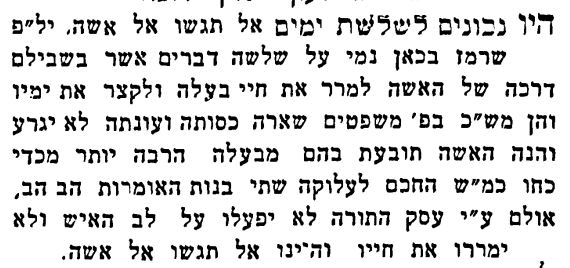
Also noteworthy the Q and A of Toras Avigdor this past week which states it is good to marry someone who you can't hold a conversation with: